
Technical.ly: Why Philadelphia Needs More Hackathons
Technical.ly published a guest post from Tony Siu and Jacob Gold on why Philadelphia needs more …
Read More
A plain explainer of Hack for Humanity events: who runs them, how civic and humanitarian hackathons are judged, and how Philadelphia builders and sponsors take part.
Hack for Humanity is a name several organizations use for hackathons that point software at a social problem: human rights, public health, the environment or civic services. The name looks like one event, but it is really a family of events. Each one has its own host, its own theme and its own rules. In this guide we explain how these social good hackathons are built, what makes them different from a product or startup hackathon, and what developers, sponsors and donors in Philadelphia should know before they take part in one or fund one.
We run a working tech community in Philadelphia. At C.O.D.E (Community of Developers & Engineers), our members code side by side every week, and we host quarterly hackathons at venues like Pennovation Works. Social good themes come up often in our rooms. Our view is shaped by watching what happens when a team tries to help real people in a single weekend: sometimes it works, and sometimes it does not.
Hack for Humanity is a recurring name for hackathons where teams build software aimed at a humanitarian, civic or environmental problem. Universities, nonprofits and AI communities each run their own version. It matters to builders who want their weekend project to count for something, and to sponsors and donors who want their support tied to a public benefit they can see.
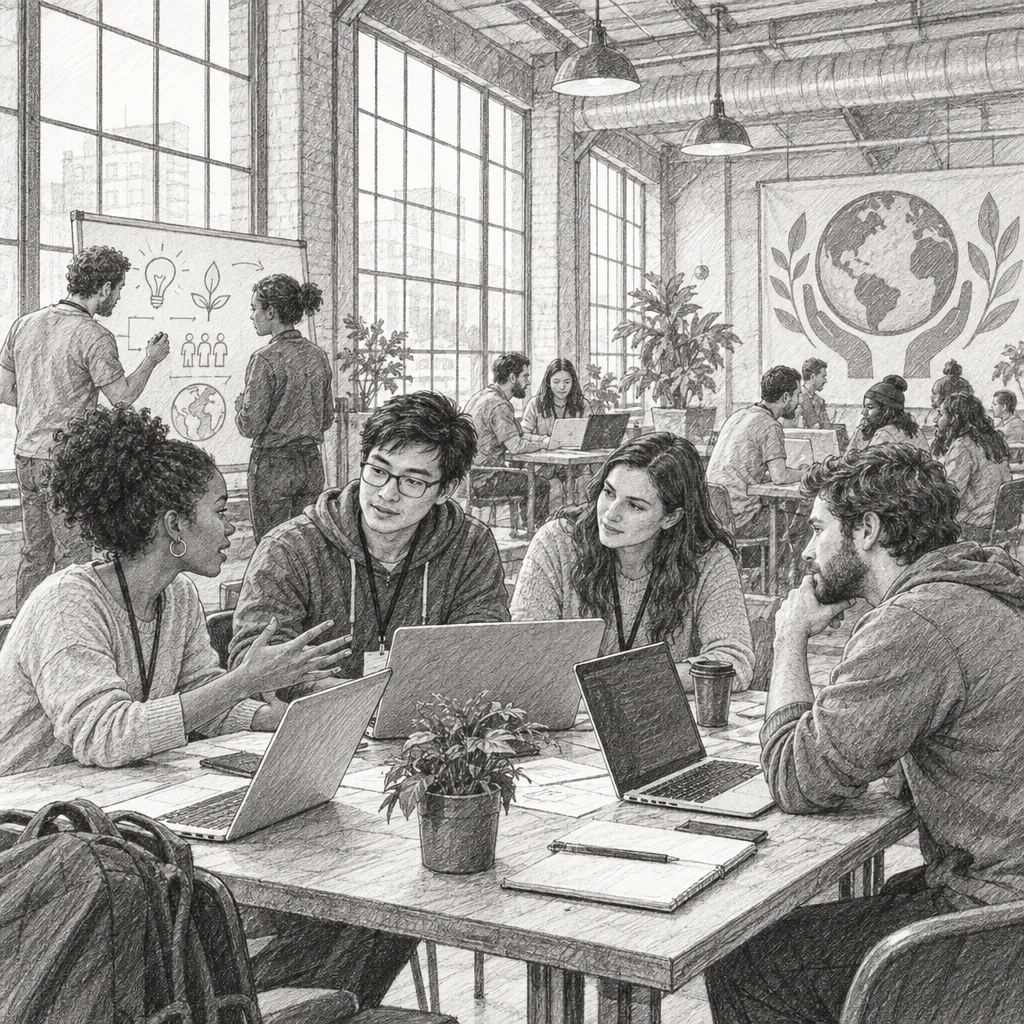 Social good hackathons pair builders with a real problem and a short deadline.
No single organization owns the name. Hack for Humanity events come from at least two kinds of hosts: universities that run a yearly student event, and nonprofit communities that organize across many cities. The host shapes everything else, including the theme, who can enter and what a finished project looks like.
Universities ran the earliest well-known versions. Santa Clara University hosted a long-running social good hackathon under the name, and its tenth annual edition took place in 2023. That event was built like most student hackathons: a public project gallery, sponsor tracks, prize categories, a panel of judges and written judging criteria.
Brown University runs a different model. Its center for human rights describes Hack for Humanity as an annual humanitarian focused hackathon at Brown University that brings students together to learn about the most pressing needs in the human rights and humanitarian sphere. Learning about the problem comes first, and the code comes second.
Brown also picks a single theme each year. The 2025 edition focused on global gun violence, and more than 600 people are estimated to die from gun violence every day, according to Amnesty International. One theme with a clear human cost gives every team the same starting point. That makes the projects easier to compare and easier to judge.
The 2026 global edition comes from a nonprofit AI community. The AI Collective announced a global civic hackathon running September 1 through October 31, 2026, across 120 chapters in 50 countries. Two months is far longer than a weekend. A window that long gives teams time to talk with the people they are building for before they write code.
Distributed civic events like this one depend on local chapters. Each chapter needs a room, mentors and people who show up. That is why city-level communities matter to a global event. A builder in Philadelphia gets more out of the format with a local table of collaborators than alone at home.

A social good hackathon is judged on whether a project could help a specific group of people. A product hackathon is judged on whether the project could become a business or show off a sponsor’s tools. That difference changes how teams spend their hours.
In our quarterly hackathons, we see teams on social themes spend far more of the first day on research. They read about the problem, find out who already works on it and narrow down to one user. Teams on open themes usually start coding within the first hour. Neither approach is wrong. They lead to different kinds of demos.
The most common failure at a social good hackathon is building for people the team never spoke to. A modest tool that one real organization will use is worth more than a polished app that solves a guessed problem.
Judges at Hack for Humanity events usually score problem understanding and potential impact alongside technical work. Exact criteria change by host, but the weighting leans toward whether the team understood the people affected.
Problem fit. Judges ask whether the team can describe who has the problem, how that person deals with it now and why the current approach falls short. A team that cites the event’s framing research, such as the firearm death figure in Brown’s 2025 brief, shows it took the theme seriously.
Feasibility. A working demo of one narrow feature beats slides about ten features. Judges want to see that the core idea runs.
Responsible design. Projects that touch personal data, location or health information get questions about privacy and misuse. Teams that answer before they are asked score better.
Path after the weekend. Judges reward a clear next step: an open repository, a partner willing to test it or documentation someone else could pick up.
Sponsors fund the parts of a social good hackathon that prizes alone do not cover. For a CSR program manager, the strongest support goes to food, venue, mentors and follow-up, because those costs decide who can take part and whether projects survive past demo day.
The table below shows the main sponsorship types and the outcome each one tends to support.
Types of hackathon support and the outcome each tends to produce
| Type of support | What it pays for | Outcome it supports |
|---|---|---|
| Venue and food | Room, meals, power and Wi-Fi | Builders without spare money can attend |
| Mentor time | Engineers and domain experts on site | Better problem fit and working demos |
| Theme partnership | A nonprofit brief and real data | Projects grounded in a real need |
| Follow-up grants | Hosting and time after the event | Projects that stay in use |
| Prizes | Cash or credits for winning teams | Recognition and motivation |
Recurring donors play a quieter role. Monthly gifts keep weekly sessions running between hackathons. Those sessions are where many teams first form, so they shape who arrives at the next event ready to build.
Philadelphia developers do not need to travel to take part in a Hack for Humanity style event. The format depends on a problem, a room and people willing to build. We have all three in our community: 5,700+ members on Meetup, 490+ active builders on Discord and weekly coding sessions where social good projects can start small and keep going.
Our themed events, like the AI Agent Hackathon, show how a single focus brings people together. A civic or humanitarian theme works the same way. When a global event like the 2026 civic hackathon runs, a local community gives Philadelphia builders a place to meet in person instead of building alone.
A hackathon competition is a time-boxed event where teams build a working software project and present it to judges, who score it against published criteria. A social good version adds a required theme and weighs the project’s potential benefit to a named group of people.
Most hackathons in 2026 allow AI coding assistants, but the rules belong to each host, so read them before you start. Many events ask teams to disclose which AI tools they used. At a humanitarian event, judges also care whether AI features handle sensitive data responsibly.
Yes, a hackathon helps a CV when you can point to a finished project, a public repository and your own role on the team. A social good project also gives you a concrete story for interviews: who the user was, what you learned from them and what you built for them.
If you want your code to help someone in Philadelphia, come build with C.O.D.E Philadelphia at a weekly coding session or our next quarterly hackathon. If you want more local builders to have that chance, you can sponsor an event, donate or volunteer with us, and your support goes toward the rooms, meals and mentors that let people of every skill level take part.
Powered by gofylo.io